


CHISEN LFP6460-T 64V 45Ah LiFePO4 Power Battery
CHISEN · LiFePO4 POWER BATTERY · E-VEHICLE
|
LFP6460-T 64V 45Ah · 2880Wh Drop-in replacement for 60V lead-acid sets · 20S LiFePO4 · 60A cont / 240A peak · IP65 · 23.2kg |
|

|
VOLTAGE 64 V |
CAPACITY 45 Ah |
CONT. CURRENT 60 A |
WEIGHT 23.2 kg |
01 Product definition & core advantages PRODUCT DEFINITION
CHISEN LFP6460-T is a 64V 45Ah (2880Wh) LiFePO4 traction pack: 20 LiFePO4 cells plus an integrated BMS in an IP65-rated case, built as a drop-in pack for E-motorcycles, E-scooters, Cargo e-tricycles, Mobility scooters.
Its voltage platform matches a 60V lead-acid set (5 × 12V), so the compartment, hold-down and cable routing can stay. The charge limit is 73V, close to the original lead-acid window. Lithium cells are less tolerant of overcharge: a 73V lithium charger is mandatory.
Match it to motors up to 3000W. With 60A continuous and 240A peak (500 ms) it covers launch, climbs and short overloads. Body type: T-type, sized to the actual compartment clearance.
|
Advantage |
This model |
What it means |
|---|---|---|
|
High-current traction |
60A / 240A (500ms) |
Less sag under load; the controller keeps its power |
|
Lightweight |
23.2kg(lead-acid approx. 82–96kg) |
~74% lighter than an equivalent lead-acid set |
|
Fast charge |
0→100% in about 2.7–13.5 h |
Top up between shifts, no overnight wait |
|
Long life |
≥2000 cycles (80% DoD, typical) |
4–6× a comparable lead-acid battery |
Cells are sorted for capacity, internal resistance and self-discharge before assembly, with intra-pack delta kept within 30mV. The BMS uses a common charge/discharge port and handles cell sensing, passive balancing and five protections: it cuts the output on a fault and recovers once cleared.
Figures follow the brochure and factory data sheet; typical values are subject to the factory test report.
02 Key specifications KEY SPECIFICATIONS
|
Item |
Value |
Item |
Value |
|---|---|---|---|
|
Nominal voltage |
64 V(20×3.2V) |
Nominal capacity |
45 Ah |
|
Battery energy |
2880 Wh |
Usable energy |
2592 Wh(90%) |
|
Series |
20S |
Chemistry |
LiFePO4 |
|
Continuous |
60 A(1.33C) |
Peak |
240 A(500ms) |
|
Charge voltage |
73 V |
Charge current |
3–15 A |
|
Charge time |
about 2.7–13.5 h |
Cut-off |
50 V |
|
Dimensions |
400×228×170 mm |
Weight |
23.2 kg |
|
Terminal |
Anderson |
IP rating |
IP65 |
|
Charge temp. |
-5~55℃ |
Discharge temp. |
-20~60℃ |
|
Motor rating |
≤3000 W |
Housing |
Sealed case, IP65 |
Core parameters above; full tables, temperature and protection thresholds in §12–§15.
03 Model naming & suffixes NAMING RULE
The code has three parts: LFP (LiFePO4) + voltage platform (51/64/76) + a two-digit series number. Suffixes denote the body type and version. Capacity and current follow the specification name and the data table, not the digits.
|
Suffix |
Meaning |
Models |
|---|---|---|
|
— |
Standard body |
LFP5120, LFP5140, LFP5160, LFP6440, LFP6480, LFP64100, LFP76110 |
|
-SEAT |
Under-seat |
LFP6460-SEAT, LFP7640-SEAT, LFP7660-SEAT |
|
-PED |
Footboard mount |
LFP6460-PED, LFP7640-PED, LFP7660-PED |
|
-T |
T-shaped body |
LFP6460-T |
|
-A |
Long body |
LFP7680-A, LFP76100-A |
|
-B |
Square body |
LFP7680-B, LFP76100-B |
|
-UP |
Upgraded capacity |
LFP64120-UP, LFP76120-UP |
This page covers LFP6460-T, body type T-type.
04 Standards & compliance STANDARDS
The table lists the standards and documents commonly used with this series and their scope. Apart from the items listed, no conformity claim is made; market-access requirements are confirmed per project.
|
Standard / document |
Scope |
Handling |
|---|---|---|
|
UN 38.3 |
Lithium battery transport test |
Test summary with goods |
|
UN 3480 · Class 9 |
Li-ion batteries shipped alone |
Declared under this entry |
|
MSDS |
Safety data sheet |
With goods |
|
Transport condition report |
Sea / air transport condition report |
With goods |
|
DG package certificate |
Export DG packaging certificate |
With goods |
|
GB 17761-2024 |
E-bike whole-vehicle standard: nominal ≤48V |
Not for 48V-limited e-bikes |
|
GB 43854-2024 |
E-bike Li batteries up to 48V |
Not applicable at 51.2V+; no claim |
|
GB/T 36972-2026 |
E-bike Li battery performance (from 2026-09-01; replaces 2018) |
Out of scope at 51.2V+ |
|
GB 36672-2026 |
E-motorcycle / e-moped Li battery safety (mandatory, from 2027-07-01) |
In scope; certification per project |
|
IEC 62133-2 |
Portable cells / batteries |
Cell-level documents available |
|
UL 1642 |
Lithium cells |
Cell-level documents available |
|
EN 50604-1 |
Light EV batteries (EU) |
Per market and customer request |
05 Construction & materials CONSTRUCTION
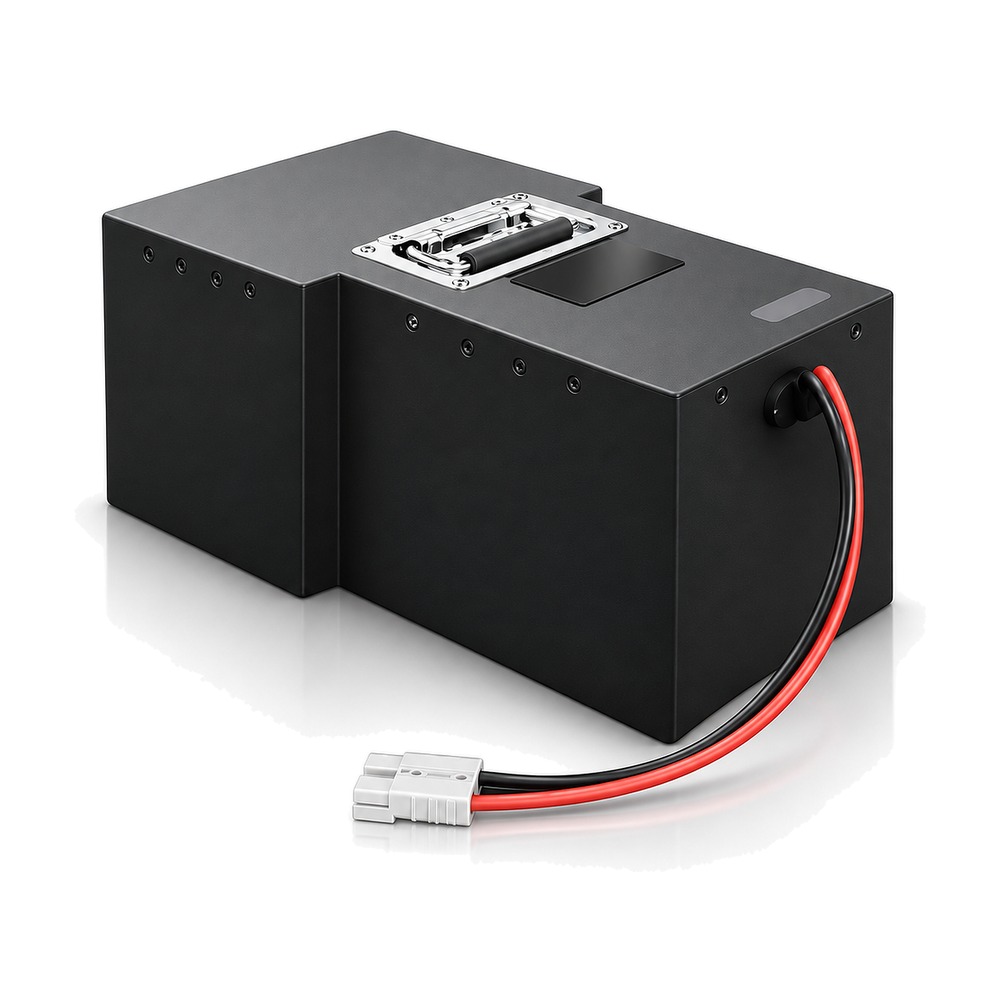
LFP6460-T pack
|
Part |
Material / spec |
Notes |
|---|---|---|
|
Cells |
LiFePO4,20S |
Prismatic aluminium case, sorted by capacity and IR |
|
BMS |
Smart board, common port |
Five protections: overcharge, over-discharge, overcurrent, short, temperature |
|
Case |
Sealed case (material by model) |
IP65, damping pad underneath |
|
Terminal |
Anderson |
Matched to the harness |
|
Harness |
Silicone wire + terminals |
Sized for continuous and peak current |
|
Sealing |
Gasket + potting |
Splash and dust |
Product images are renderings (AI-generated); terminal type, label and cosmetic details follow the physical unit and factory data sheet.
06 Full series (20 models) SERIES
|
Model |
V |
Ah |
Wh |
Cont. |
Size mm |
kg |
Motor |
|---|---|---|---|---|---|---|---|
|
LFP5120 |
51.2V |
15Ah |
768Wh |
20A |
300×185×82 |
5.5kg |
≤720W |
|
LFP5140 |
51.2V |
30Ah |
1536Wh |
40A |
183×156×285 |
10.5kg |
≤1500W |
|
LFP5160 |
51.2V |
45Ah |
2304Wh |
60A |
220×160×330 |
18.5kg |
≤2300W |
|
LFP6440 |
64V |
30Ah |
1920Wh |
40A |
220×160×301 |
16.4kg |
≤2000W |
|
LFP6460-PED |
64V |
45Ah |
2880Wh |
60A |
410×210×175 |
23.5kg |
≤3000W |
|
LFP6460-SEAT |
64V |
45Ah |
2880Wh |
60A |
220×180×340 |
22.3kg |
≤3000W |
|
LFP6460-T |
64V |
45Ah |
2880Wh |
60A |
400×228×170 |
23.2kg |
≤3000W |
|
LFP6480 |
64V |
60Ah |
3840Wh |
80A |
410×260×175 |
30.6kg |
≤3800W |
|
LFP64100 |
64V |
75Ah |
4800Wh |
80A |
410×330×175 |
38.0kg |
≤4800W |
|
LFP64120-UP |
64V |
100Ah |
6400Wh |
100A |
510×330×190 |
49.7kg |
≤6000W |
|
LFP7640-SEAT |
76.8V |
30Ah |
2304Wh |
40A |
220×160×330 |
18.7kg |
≤2300W |
|
LFP7640-PED |
76.8V |
30Ah |
2304Wh |
40A |
360×180×170 |
18.7kg |
≤2300W |
|
LFP7660-SEAT |
76.8V |
45Ah |
3456Wh |
60A |
255×175×375 |
27.1kg |
≤3500W |
|
LFP7660-PED |
76.8V |
45Ah |
3456Wh |
60A |
460×210×175 |
27.3kg |
≤3500W |
|
LFP7680-A |
76.8V |
60Ah |
4608Wh |
80A |
534×230×168 |
35.6kg |
≤4500W |
|
LFP7680-B |
76.8V |
60Ah |
4608Wh |
80A |
460×260×175 |
35.1kg |
≤4500W |
|
LFP76100-A |
76.8V |
75Ah |
5760Wh |
80A |
640×230×168 |
43.4kg |
≤6000W |
|
LFP76100-B |
76.8V |
75Ah |
5760Wh |
80A |
460×330×175 |
43.0kg |
≤6000W |
|
LFP76110 |
76.8V |
90Ah |
6912Wh |
90A |
670×280×165 |
52.2kg |
≤7000W |
|
LFP76120-UP |
76.8V |
100Ah |
7680Wh |
100A |
500×375×190 |
58.1kg |
≤8000W |
Models on the same platform are interchangeable by compartment and motor; do not swap across platforms.
|
Platform |
Series |
Replaces |
Typical vehicles |
Models |
|---|---|---|---|---|
|
51.2V |
16S |
48V(4×12V) |
E-moped / e-scooter / light trike |
LFP5120–LFP5160 |
|
64V |
20S |
60V(5×12V) |
E-motorcycle / scooter / cargo trike |
LFP6440–LFP64120-UP |
|
76.8V |
24S |
72V(6×12V) |
High-speed e-moto / heavy trike / sightseeing |
LFP7640–LFP76120-UP |
07 Applications APPLICATIONS
Typical fitments for LFP6460-T: E-motorcycles, E-scooters, Cargo e-tricycles, Mobility scooters.
|
Vehicle |
Typical load |
Motor |
Guidance |
|---|---|---|---|
|
E-motorcycles |
≤150kg |
≤3000W |
Urban commuting: weight and charge time |
|
E-scooters |
150–300kg |
≤3000W |
Primary use for this model |
|
Cargo e-tricycles |
300–500kg |
≤3000W |
Keep 20% power headroom on hilly routes |
|
Mobility scooters |
Vehicle-dependent |
≤3000W |
Check compartment and terminal |
E-scooter (e-moped)
Cargo e-tricycle
Motors up to 3000W. Sustained over-power or long full-load climbs trip BMS current limiting and are excluded from warranty. Not for 48V-limited e-bikes: a 51.2V pack exceeds the GB 17761-2024 vehicle limit.
08 Lead-acid comparison VS LEAD-ACID
|
Item |
Original 60V lead-acid |
CHISEN LFP6460-T |
|---|---|---|
|
Nominal voltage |
60V |
64V |
|
Full-charge voltage |
approx. 73.5V |
73V |
|
Usable energy (same nominal) |
about 80% |
about 90% |
|
Weight |
82–96kg |
23.2kg |
|
Cycle life |
300–500 (50% DoD) |
≥2000 (80% DoD, typical) |
|
Charge efficiency |
70–85% |
≥95% |
|
Maintenance |
Water, equalising, sulphation |
Maintenance-free, no acid mist |
|
Cold |
Noticeable loss at -10℃ |
Discharge to -20℃; avoid charging below 0℃ |
|
Charger |
Lead-acid type |
73V lithium (must change) |
Note: lead-acid capacity is rated at the 20-hour rate; about 80% is usable in practice, depending on discharge rate and cut-off. 50% DoD is a recommendation for cycle life, not the usable limit.
By weight, LFP6460-T is about 74% lighter than an equivalent lead-acid set; cost per kilometre is in §11.
09 Selection guide SELECTION
|
Requirement |
Recommendation |
Why |
|---|---|---|
|
Urban commute ≤40km/day |
64V 22–45Ah |
30% headroom; shallow cycles last longer |
|
Cargo / hilly |
This model or one size up |
Current headroom avoids limiting |
|
Swap / rental |
Same platform, same batch |
Parallel needs a factory scheme |
|
Cold climate |
This model + insulated bay |
Avoid charging below 0℃ |
|
E-bike (48V limit) |
Not suitable |
51.2V exceeds the 48V vehicle limit (GB 17761-2024) |
|
Long range |
One capacity step up |
More energy, more weight |
10 Range formula & examples RANGE
Range = usable energy ÷ consumption. Usable energy is 90% of nominal; consumption by vehicle class (e-moped/scooter 22–32, e-motorcycle 35–50, cargo trike 45–65Wh/km).
|
Condition |
Wh/km |
Usable Wh |
Estimated range |
|---|---|---|---|
|
Light load, flat, 25km/h |
35 |
2592 |
74 km |
|
Normal load, mixed |
42 |
2592 |
61 km |
|
Heavy load, hills, cold |
50 |
2592 |
52 km |
Example: LFP5120 has 691Wh usable — about 20km at 35Wh/km and 31km at 22Wh/km. Size on the heaviest duty cycle, then add 20% headroom.
Estimates for sizing only, not a range warranty; actual range depends on speed, load, tyre pressure, temperature and terrain.
11 Cycle life & TCO TCO
At one cycle a day and 80% DoD, 2000 cycles is about five and a half years; lead-acid at 300–500 cycles needs replacing every 1–2 years. The table indexes three-year cost against lead-acid = 100 (electricity price differences excluded).
|
Item |
Lead-acid |
This model |
|---|---|---|
|
Replacements in 3 years |
2 |
1 |
|
Purchase index (3-year) |
200 |
160–200 |
|
Maintenance index |
25 |
0 |
|
Energy index |
100 |
80 |
|
3-year total index |
100 |
74–86 |
Lead-acid is usually replaced every 1–2 years — about two sets in three years; 2000 cycles at one charge a day lasts over five years with no replacement. The purchase price is roughly 60–100% higher, but saved labour, downtime and charging cost usually pay it back in about two years.
Indices are a model based on published parameters; actuals depend on price, tariff and duty cycle.
12 Charging & temperature CHARGING
|
Ambient |
Suggested current |
Notes |
|---|---|---|
|
0–15℃ |
≤0.1C (about 1.5–4.5A) |
Lower current; charge to 90% |
|
15–35℃ |
3–15A |
Best window; full charge fine |
|
35–45℃ |
≤0.2C |
Ventilate; avoid direct sun |
|
<0℃ |
Not recommended |
Warm to 5℃ or above first |
|
>45℃ |
Stop charging |
Wait until below 45℃ |
Charger: 73V CV, 3–15A CC (CC/CV) with overcharge protection. Never use a lead-acid or higher-voltage charger.
13 Operating temperature TEMPERATURE
|
Mode |
Range |
Notes |
|---|---|---|
|
Discharge |
-20~60℃ |
Capacity drops below 0℃ |
|
Charge |
-5~55℃ |
BMS allows; not advised below 0℃ |
|
Storage |
-10~35℃ |
Dry, shaded, 40–60% SoC |
14 Self-discharge & storage STORAGE
|
Item |
Value |
Notes |
|---|---|---|
|
Monthly self-discharge |
<3% |
Typical at 25℃ |
|
Storage SoC |
40–60% |
For long storage |
|
Top-up interval |
Every 3 months |
Back to about 50% |
|
Storage temp. |
-10~35℃ |
Avoid condensation and sun |
Storing at low SoC causes irreversible capacity loss; for more than six months, top up every three months.
15 Current limits & cut-off LIMITS
|
Parameter |
Value |
Notes |
|---|---|---|
|
Continuous discharge |
60 A |
1.33C continuous rating |
|
Peak discharge |
240 A |
500 ms, launch / climb |
|
Charge current |
3–15 A |
CC/CV |
|
Discharge cut-off |
50 V |
20×2.5V, BMS cut-off |
|
Charge cut-off |
73 V |
20×3.65V |
|
Balancing |
Passive |
At end of charge |
16 OEM / ODM CUSTOMISATION
|
Customisable |
Range |
MOQ & lead time |
|---|---|---|
|
Capacity |
45Ah ±20% |
50 pcs / 30–45 days |
|
Terminal |
Pin / Anderson / stud / one-wire |
50 pcs / 30–45 days |
|
Case & colour |
Powder colour, silkscreen |
100 pcs / 35–50 days |
|
Label & packaging |
Private label, manual, box |
100 pcs / 30–45 days |
|
BMS settings |
Limits, cut-off, comms |
Per project |
|
Certification |
UN38.3 / MSDS / transport report |
With goods |
Custom flow: requirement → mechanical/electrical proposal → sample (3–5 days) → customer validation → pilot batch (30–45 days) → mass production. Labels, packaging and manuals can carry the customer's brand.
Standard orders ship in 7–15 days; samples in 3–5 days. Custom projects are sampled before mass production.
|
Packing / documents |
Contents |
Notes |
|---|---|---|
|
Carton |
1 pack + foam + carton |
Printable to order |
|
Pallet |
Stacked per container |
Sea-freight bracing |
|
Documents |
Certificate, manual, UN38.3 summary, MSDS |
Per destination language |
|
Transport |
UN 3480 Class 9 |
DG packing per forwarder |
17 FAQ (18) FAQ
|
Question |
Answer |
|---|---|
|
Can it replace my 60V lead-acid set? |
Yes — same platform and a body designed for the original compartment. But fit a 73V lithium charger and check the controller cut-off and dashboard. |
|
Which charger? |
73V CV, 3–15A CC with overcharge protection; never a lead-acid or higher-voltage unit. |
|
How far will it go? |
About 52–74km from 2592Wh usable at 35–50Wh/km; confirm on the road. |
|
Winter use? |
BMS accepts -5 to 55℃ charging; below 0℃ hurts life, so warm to 5℃ first. Discharge works to -20℃. |
|
Can I parallel two packs? |
Do not parallel or series packs yourself; the factory supplies matched packs with a wiring scheme. |
|
Warranty? |
24 months or as contracted; over-power, wrong charger, dismantling, water and impact damage are excluded. |
|
Why does the BMS not reset? |
Disconnect the load, wait 1–2 minutes and re-power; if it stays off, wake it with a matching charger or contact service. |
|
Can I use a lead-acid charger in an emergency? |
No. Lead-acid chargers lack Li-ion CV/CC control and will overcharge; warranty is void. |
|
How much clearance? |
At least 400×228×170mm, with 10mm around for air and vibration. |
|
Can the terminal be changed? |
Pin, Anderson, stud or one-wire are available, specified at order. |
|
How is it shipped? |
As UN 3480 Class 9; UN38.3 summary, MSDS and transport report travel with the goods. |
|
Certifications? |
UN38.3, MSDS and transport report with goods; ISO 9001/CE on request, holder and models per the certificate. |
|
Custom capacity? |
Within ±20% of 45Ah, with BMS and case re-checked; MOQ 50. |
|
Warranty replacement? |
Send the serial number and symptom; a replacement ships first, the old unit returns for analysis. |
|
Can it be used for storage? |
This is a traction design; for storage choose the ST series with longer cycle life. |
|
Can it fit a 48V e-bike? |
No. The e-bike standard limits nominal voltage to 48V (GB 17761-2024); this 51.2V pack is outside that limit. Choose a 48V-or-below battery. |
|
What if the pack swells? |
Stop using it, ventilate, keep away from combustibles, contact service and do not recharge. |
|
End-of-life recycling? |
We can help route packs to recycling; never dispose of them as household waste. |
18 Maintenance & troubleshooting MAINTENANCE
|
Interval |
Task |
Criterion |
|---|---|---|
|
Each trip |
SoC, noise, harness |
SoC ≥20%, nothing loose |
|
Monthly |
Terminals and mounts |
No corrosion, torque in spec |
|
Quarterly |
Capacity and delta V |
Delta <50mV |
|
Yearly |
Insulation and case |
≥1MΩ, no deformation |
|
Symptom |
Likely cause |
Action |
|---|---|---|
|
No output |
BMS protection / open harness |
Reset, check harness |
|
Range drop |
Cold / cell imbalance |
Warm up, balance |
|
Charging stops |
Wrong charger / temp protection |
Check charger voltage |
|
Current limiting on hills |
Over-power / heat |
Reduce load or step up |
19 Installation checklist INSTALLATION
Suggested sequence: fix the pack and damping pad, then the harness and terminals, then the charger for the first charge. Measure insulation and cell delta after each step before moving on.
|
No. |
Check |
Requirement |
|---|---|---|
|
1 |
Compartment clearance |
≥ 400×228×170mm, 10mm all round |
|
2 |
Mounting position |
Per body type: under-seat / footboard / T |
|
3 |
Fixings |
Hold-down or strap; never gravity alone |
|
4 |
Damping |
Rubber pad; no sharp edges |
|
5 |
Terminal torque |
Per terminal spec, with washer |
|
6 |
Cable gauge |
Sized for 60A / 240A |
|
7 |
Fuse |
Per vehicle spec, near the pack |
|
8 |
Charger |
73V lithium charger, matching plug |
|
9 |
Insulation |
≥1MΩ after assembly |
|
10 |
First charge |
0.2C first charge after checks |
20 Safety & prohibited use SAFETY
|
Risk |
Consequence |
Prevention |
|---|---|---|
|
Overcharge |
Swelling, thermal runaway |
Correct charger + BMS |
|
Short circuit |
Fire, blown fuse |
Insulation, fuse, keyed connectors |
|
Immersion |
Insulation failure |
IP65 is splash-only; no immersion |
|
Mechanical damage |
Internal short |
Secure mounting, avoid impact |
|
High temperature |
Derating, shorter life |
Avoid sun and heat sources |
Emergency: on swelling, smell or abnormal heat, cut power, move the pack away from combustibles and ventilate. For fire use dry powder or plenty of water to cool; never move a pack that is heating.
Prohibited: lead-acid or higher-voltage chargers; sustained over-power; dismantling or DIY series/parallel; immersion; charging below -5℃ (warm the pack above 0℃ first); using a damaged pack.
21 Manufacturing & service CAPABILITY
|
Metric |
Value |
Notes |
|---|---|---|
|
Manufacturing |
30+ years |
Battery R&D and manufacturing |
|
Production bases |
7 |
China + Vietnam |
|
Annual capacity |
10 GWh |
Li-ion and lead-acid |
|
Distributors |
2000+ |
Exports to 60+ countries |
LiFePO4 module and BMS assembly is based in Guangdong, with lead-acid and system engineering in Zhejiang; cell, BMS and pack integration under one roof.
22 Contact CONTACT
|
Channel |
Details |
|---|---|
|
|
sales@chisen.cn |
|
Phone / WhatsApp |
+86 131 6622 6999 |
|
Website |
https://www.chisen.cn |
|
Please quote |
model LFP6460-T, vehicle, quantity, market |
Service: quotes answered within one working day; technical questions answered within 24 hours; volume orders include spares, training and a named service contact.
Samples: standard models ship in 3–5 days; custom samples start once the drawing and BMS settings are confirmed.
Specifications are taken from the current brochure and factory data sheet. Figures marked as estimates or typical values are subject to test reports. Specifications may change without notice.